Open Improv Collective
Three proof-of-concept experiments exploring how audiences can participate in free improvisation through game pieces embedded in technology—transforming listeners into active co-creators.
Overview
My undergraduate thesis investigating a specific problem in free improvisation: while musicians are ecstatic exploring sound without constraints, audiences are consistently left confused or wanting to participate but having no way in. The solution? Game pieces—compositional frameworks inspired by board games, sports, and visual scores—embedded in technology that let listeners become active participants without requiring traditional musical training.
The research drew from John Zorn’s COBRA and other improvisation frameworks, interviews with experienced improvisers, and game theory. Rather than building a single product, I developed three distinct proof-of-concept experiments, each exploring different paradigms of audience-performer interaction through technology.
The Three Experiments
PONG
A musical take on the classic video game where two keyboard players have a conversation controlled by the audience. Built with p5.js and WEBMIDI.js on the frontend, ESP32 microcontroller with potentiometers for audience control, and Node.js handling real-time communication via WebSockets.
The concept explores trading in jazz—musicians taking turns playing solos—but with the audience manipulating the speed and flow of conversation. Two MIDI keyboards act as paddles in a Pong game projected for everyone to see. Audiences adjust game speed and instrument volumes through physical controllers, directly influencing the musical dialogue without dictating what gets played.
Chatting Drums
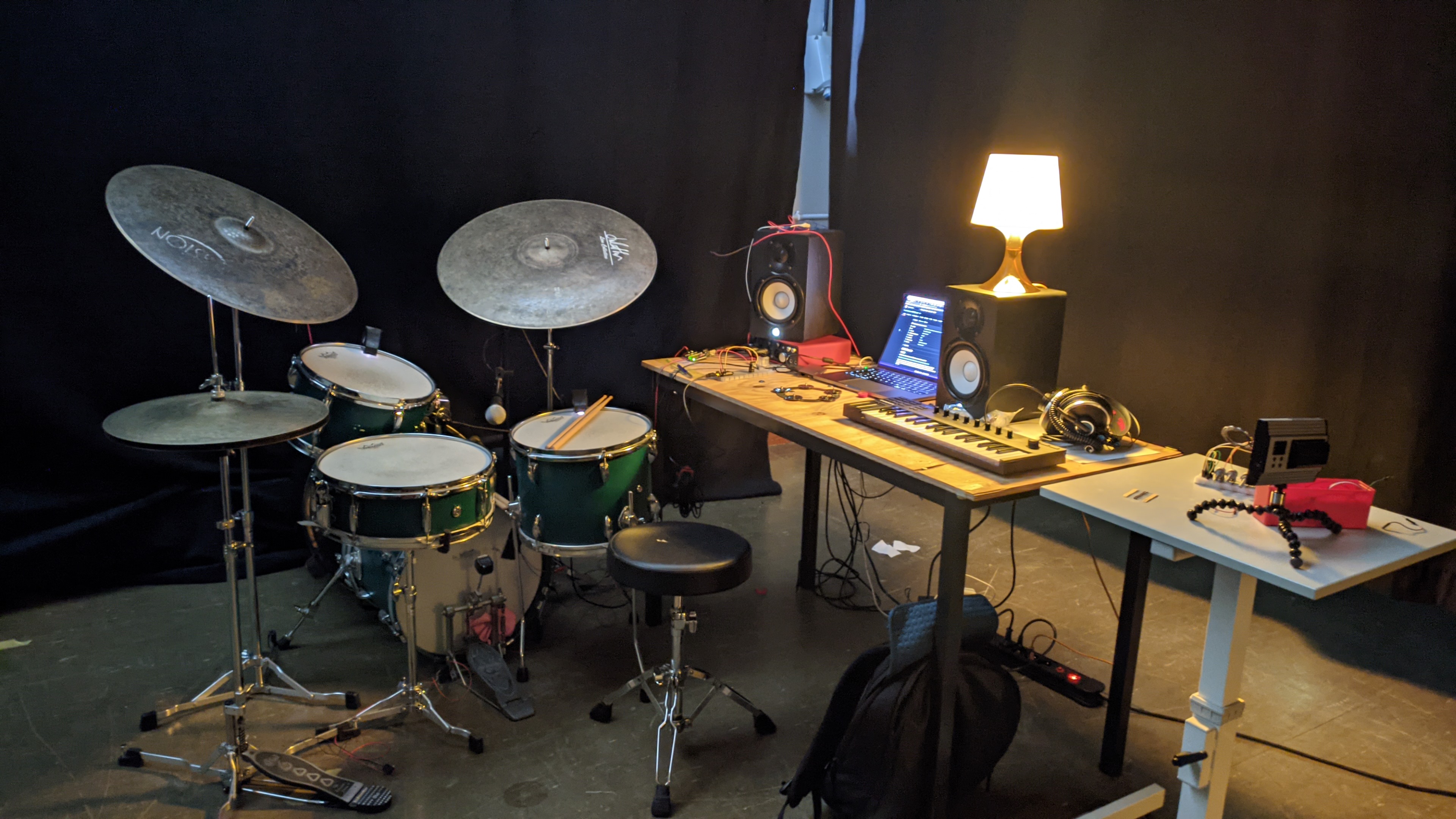
A drum set extended with Sensory Percussion triggers, piezo sensors, and Arduino to function as both a musical instrument and a text communication device. Drummers type messages into a chatroom by playing different drum parts mapped like an old phone keypad, while audiences chat back, creating a hybrid conversation between spoken language and musical language.
Built with Sensory Percussion MIDI triggers, custom Arduino circuits with piezo sensors for kick drum and cymbal, Node.js server with Socket.io for the chatroom, and WEBMIDI.js processing the drum inputs. The system transforms how drummers can communicate, mixing linguistic and sonic expression in real-time performance.
Blocks & Structuralism
The simplest but most effective experiment. A web-based voting system where audiences democratically choose which page of Cornelius Cardew’s graphic score “Treatise” the band interprets next. Every 60 seconds, four random pages appear as voting options—whichever gets the most votes becomes the next musical material.
Built entirely with web technologies: Node.js, Socket.io, Express, with Tailwind CSS and DaisyUI for the interface. The concept levels the playing field—since Treatise has no instructions or legend, everyone (musicians and audience alike) is constantly reinterpreting visual symbols into sound. Musicians remain free to interpret however they want; audiences suggest the material, not the execution.
Technical Approach
All three experiments prioritized maintaining musical freedom while creating meaningful audience participation. Technologies varied by concept:
- PONG: ESP32 microcontroller, p5.js, WEBMIDI.js, Socket.io, Vite
- Chatting Drums: Arduino Uno, Sensory Percussion triggers, piezo sensors, Node.js, Socket.io, WEBMIDI.js, Ableton Live
- Blocks & Structuralism: Pure web stack with Node.js, Socket.io, Express
Each prototype taught different lessons about the balance between direction and freedom, immediacy versus complexity, and how abstraction creates space for interpretation.
What Happened
Nominated for Best Smart Technology Project 2022 at Erasmushogeschool Brussel Final Show. The project demonstrated that free improvisation could be made participatory and accessible when audiences are given frameworks that don’t require musical expertise.
The experiments progressed from complex (PONG’s physical game mechanics) to simple (Blocks’ democratic voting), with the simplest proving most effective. This research became the foundation for continued exploration of human-machine co-creation in my NYU thesis work on Improvisational Syntax.